Hold On to That Feeling
Find something you really like to do, even if it seems strange or uncommon.
Every Wednesday for twenty years, Jan Mul of the Netherlands took a train to Amsterdam's Schiphol Airport. From there, he'd fly to another European city — often Stockholm, but sometimes Barcelona, Helsinki, or Hamburg. Upon arrival, he'd spend an hour or two walking around the terminal, then board another flight back to Amsterdam.
That was the extent of the trip: no sightseeing or souvenir shopping involved.
Jan Mul did this almost every week for two decades — more than a thousand flights in total, all with the same rituals of selecting a window seat, looking out at the sky from thirty thousand feet, and airport-terminal wandering.
I know what some people will think when they read his story: what a waste. All that traveling without any real travel. But of course, those people weren't Jan Mul. For him, this weekly ritual made him happy. He liked being up in the air, and he enjoyed the sense of soft adventure he felt in flying to nowhere.
He'd built the ritual into his lifestyle. Because he didn't care about the destination, he booked whichever flight was cheapest — and because he returned the same day, the weekly trips didn't take him away from home for long.
I think of this story whenever I'm trying to decide what to do next. It makes me smile, partly because I too love traveling with no great sense of obligation to do something at my destination, but also because it's inspiring in a different way. Unlike many people, Jan Mul knew what made him happy and wasn't afraid to pursue it. He also traveled for pure enjoyment, not as a means to some other end.
Starting point
What makes you happy?
If you want to be like Jan Mul — perhaps without flying to a random city every week and never leaving the airport — you first need to understand what makes you happy.
It seems like a simple exercise. But if you know how to be happy, why do you feel anxious? Why does the sense of time's passing seem so overwhelming? For some of us, it's because of the belief that nearly everything we do must conform to some form of utility. Doing something that isn't in service of a clearly defined goal or relationship feels strange and uncomfortable.
Intuitively, you might have an idea of something that would make you happier, but you struggle with overcoming this belief about utility. You might need a nudge in the right direction. Here's a tip: to be happier (and less anxious), start with feeling more alive.
"Alive" is a funny word for a feeling. You're always alive, at least until you're dead. But you don't always feel that way. Many days, much of the time, you continue without feeling one way or another. You adopt the classic British wartime slogan: "Keep Calm and Carry On." That might be a good way to survive a war, but it doesn't help when you're stressed out and not sure you're spending your time well. If you keep doing the same things, you'll continue to feel the same way.
So as you've been trying to pay closer attention throughout your day, try to notice the standout moments where the world comes into sharper focus. When you encounter moments where you feel more alive than usual, they might startle you at first. "Oh. I feel alive. Wow."
Three ways it shows up
The moments where it happens
By surprise
You're suddenly aware that a fresh strawberry tastes delicious. You're out for a walk and realize the sun is shining. You're having dinner with your partner or a friend, and the time flies by.
Big or small
You go to a concert for the first time in a while. When the band starts playing, you remember how much you like live music. You've missed this. It makes you feel alive. You should do it more often.
Entire days
There are things you do that create this sense of greater awareness. When you're in them, everything else becomes less significant. Problems don't disappear, but they no longer take up as much space.
When you've been in a long period of sadness or depression, these moments of aliveness can be especially noticeable. For me, a moment like this feels as though the sky is opening up.
What it feels like
I've been feeling distressed, and all of a sudden, it's like someone has tapped my shoulder and said, "Hey, no need to be so worried. It's going to be okay. Also, look at the sky."
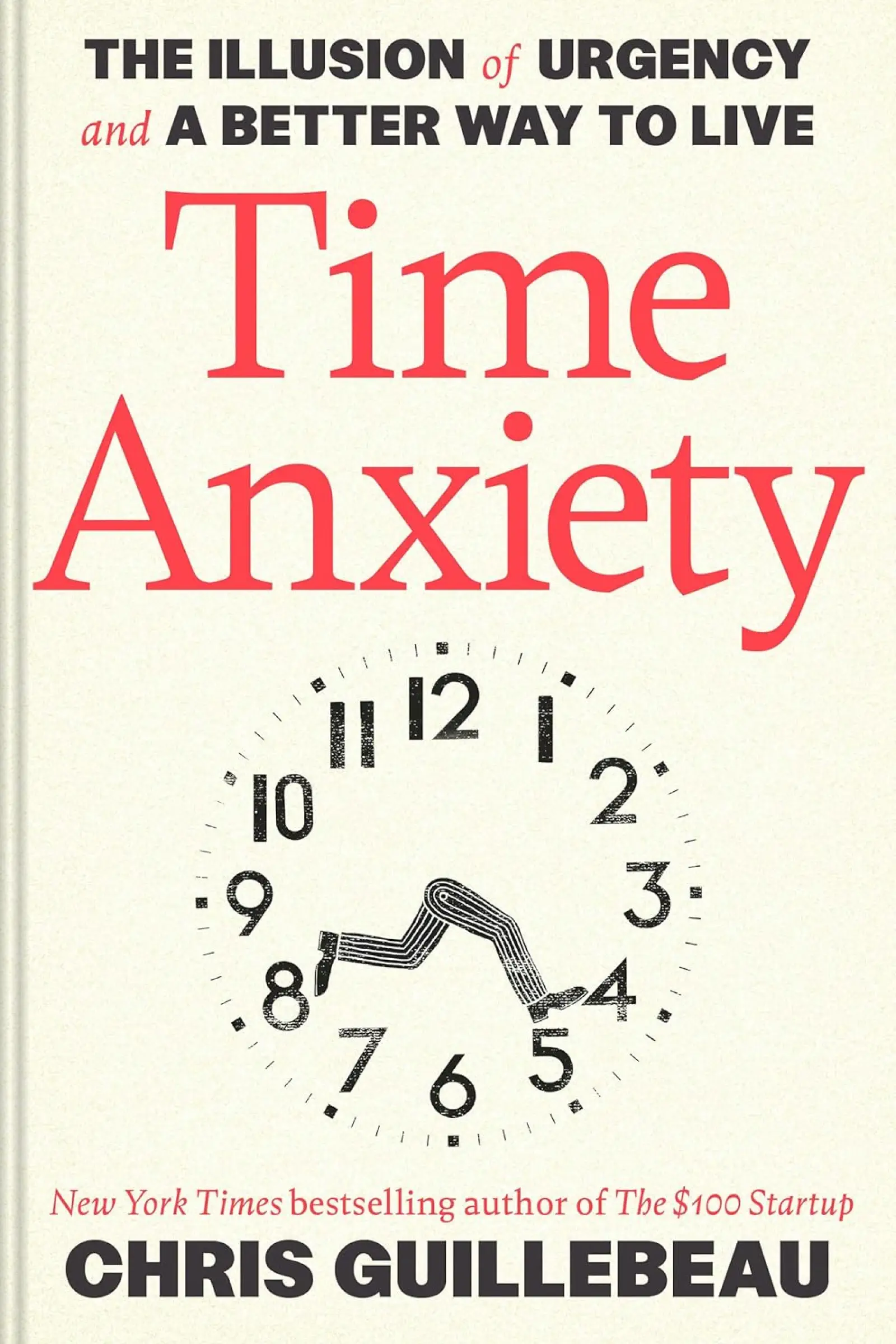
— Chapter 20 of Time Anxiety by Chris Guillebeau
If you've been sad or depressed, experiencing moments like these probably aren't the end of those feelings. Experiencing the highlights in addition to the sadness is essential. The highlights provide a break, a reprieve, and maybe even a guidepost of where you need to focus your attention more.
Because time is limited, you want to capture more of these experiences — not once in a while. Ideally, you want to feel alive every day. This is a powerful antidote to feeling overwhelmed.
A harder truth
The person you're neglecting is yourself
When you struggle with time anxiety, you might be experiencing a form of cognitive dissonance: a gap between your beliefs and your behavior. You know you can't do everything, but you keep trying — and you keep failing.
It's not letting down other people that's the problem. You're also letting yourself down. You deserve better.
It's hard to do what makes you happy, usually because you're not used to it, and because other people don't always understand it.
For anyone who struggles to prioritize their own happiness, know this: the person you're neglecting the most is yourself. This is especially true for anyone in a service role who especially likes to help others. Breaking out of that expectation — or at least modifying it somewhat — is hard. It's also an important key to feeling more purposeful.
A personal inventory
Build a memory bank of alive experiences
Even though you intuitively know some of what makes you happy, it can be helpful to reflect on a broader set of experiences. Start by making a list of times you've felt alive. These could be recent memories or times from long ago.
Here's a short list of a few of my memories (jotted down quickly without overthinking):
- Hosting a world record attempt for the most people dressed in dinosaur costumes
- Traveling through the night on a train in Eastern Europe
- Connecting with a friend I hadn't seen or talked to in a while
- Volunteering for a cause or campaign I cared about
- Solving a problem in a book manuscript and making progress
- Taking my event team to an obstacle course activity
- Speaking on a stage in front of a lot of people
Sometimes the magic comes from a unique, one-off experience — hosting the world record attempt — and other times from something you do often. For the recurring memories, my mind often goes to running outside. Not every run is magical — in fact, most aren't — but for me there's something special that occurs often enough to make the magic worth chasing.
One note: if you're making a list of your own, be wary of adding activities like "watching TV." Passively watching a screen isn't the best remedy for feeling less anxious about time. Bingeing causes more time to pass with nothing to show for it.
Once you have a list, identify some repeating elements. What do some of the activities have in common? For me, they include:
With this list, I can see that several activities on my memory bank connect to these elements. Hosting events requires hard work — and can be challenging — but when done well, they can make people happy.
Some repeat elements aren't about service to others. When I was traveling all the time, it didn't have much to do with anyone other than me. Feeling more alive often relates to looking within yourself, not outside.
Jan Mul's weekly jaunts were not in service to anyone. They recharged his batteries and allowed him to be more helpful elsewhere. Remember: you want to find the things that make you feel most alive. Follow that feeling. Chase the sun.
From the readers
Random acts of feeling alive
For many people, the idea of flying to nowhere — and then repeating the same trip every week for twenty years — is preposterous. But Jan Mul's story points to an important principle: doing random things can make you happy. If you like to do something that might be considered strange or odd to other people, you might have found an important clue to making the most of your time.
I asked my readers for examples of something unusual that makes them happy:
I love going to nice restaurants by myself. Some people never eat out alone, but I really enjoy it. I bring a book and a journal, and I always order dessert.
Every year I take up a new hobby, or at least try it out for a while. This year I've been into metal detecting, which definitely qualifies as weird to most people. I enjoy it, and I also like the fact that I decided to try it even though it seems strange.
I'm trying to go on every major roller coaster in North America. There are more than a thousand of them, so it will take a while, but the joy is in the journey. I like planning my next road trip while watching online videos about the roller coasters I'll encounter.
Answers like these align with Jan Mul's weekly flight-to-nowhere habit. If it's fun for you, do it. Do more of what makes you happy, even if other people don't understand it.
A practice for working with it
Make your own alive list
Build your memory bank
A four-step exercise to find what makes you feel most alive — and turn it into something you can act on this week.
-
List 7–10 alive moments
Set a timer for five minutes. Write down times — recent or from years ago — when you felt most alive. Don't overthink it. Speed and honesty matter more than polish.
Prompt: When did time feel good instead of threatening?
-
Find the repeating elements
Look across your list for patterns. What do two or three of those moments share? Write down the underlying elements — challenge, connection, creation, freedom, whatever fits.
Prompt: What's the common thread between your best moments?
-
Identify one element to add more of
Pick one element from your list that's currently underrepresented in your life. This week, look for one moment where you could invite more of it in — even briefly.
Prompt: Which element have you been neglecting?
-
Pick one small action
Choose something concrete you can do in the next seven days that connects to your chosen element. It doesn't need to be big — Jan Mul started with one Wednesday flight.
How it ended
The last flight
Jan Mul took his usual trip from Amsterdam airport. This time, he was accompanied by his grandson Tom, who dreamed of becoming a pilot. The trip was uneventful, as most of these trips were — at least until it took on greater significance as the last flight Jan Mul would ever take.
Two days later, he had a heart attack at the grocery store and died. His life of daydreaming through European airports was over, but he'd lived well.
Whether you're struggling with your day-to-day or seeking a greater purpose — or both — feeling more alive is a great start.
There's a sense we experience when we feel most alive. Life is fleeting, and we can't do it all. Find the things you truly enjoy and do more of them.
From the book
Hold On to That Feeling is Chapter 20 of Time Anxiety: The Illusion of Urgency and a Better Way to Live. The full chapter develops the idea of aliveness across the whole arc of the book's later sections — how it connects to purpose, to the reality of death, and to what it means to spend your finite time well.
Get the book →